Table of Contents
ToggleBuilding a backyard sport court turns unused lawn into year-round family entertainment. Instead of shuttling kids to crowded parks or paying gym fees, homeowners can install a dedicated play surface that serves multiple sports and activities. Whether the goal is shooting hoops, playing pickleball, or setting up badminton nets, a well-planned court adds functional square footage to outdoor living space. The investment pays off in active family time, property value, and eliminating the question of “what should we do today?” This guide walks through court types, surface materials, layout considerations, and practical planning steps to build a sport court that fits the yard and budget.
Key Takeaways
- Backyard sport court ideas create year-round family entertainment while increasing property value by 50-70% of installation costs, similar to premium outdoor amenities like pools and kitchens.
- Multi-purpose courts maximize versatility by combining basketball, pickleball, and other sports on a single 30×50-foot surface using color-coded striping to prevent confusion.
- Select surface materials based on budget and durability: asphalt costs $3-5/sq ft, concrete $6-9/sq ft, modular tiles $4-12/sq ft, and synthetic turf $8-15/sq ft, each with distinct maintenance requirements.
- Proper planning prevents costly mistakes—measure twice, orient courts north-south to avoid sun glare, ensure 1% minimum drainage slope, and allow 5-10 feet of clearance around play areas.
- A basic 30×50-foot multi-sport court costs $8,000-12,000 with DIY labor savings of 30-40%, while phased installation spreads expenses over multiple seasons without sacrificing functionality.
Why Build a Backyard Sport Court?
Sport courts deliver measurable benefits beyond recreational value. They provide structured play areas that keep children active and outdoors, reducing screen time without parental nagging. For adults, a court eliminates excuses, no gym commute, no membership fees, no waiting for equipment.
Property value typically increases with functional outdoor improvements. Appraisers view sport courts as premium amenities, similar to pools or outdoor kitchens, especially in family-oriented neighborhoods. The return on investment varies by region and material choice, but quality installations often recoup 50-70% of costs at resale.
From a practical standpoint, courts consolidate athletic gear. Instead of storing balls, nets, and equipment inside, everything lives in a weatherproof shed adjacent to the play area. Defined boundaries also protect landscaping, trampled flower beds and worn patches disappear when high-traffic activity moves to a designated zone.
Maintenance stays minimal compared to traditional lawns. No mowing, aerating, or reseeding. Most court surfaces require occasional sweeping, pressure washing, and crack repair. Seasonal prep involves removing debris and checking for drainage issues, tasks that take minutes rather than hours.
Popular Sport Court Options for Your Backyard
Multi-Purpose Courts: Basketball, Pickleball, and More
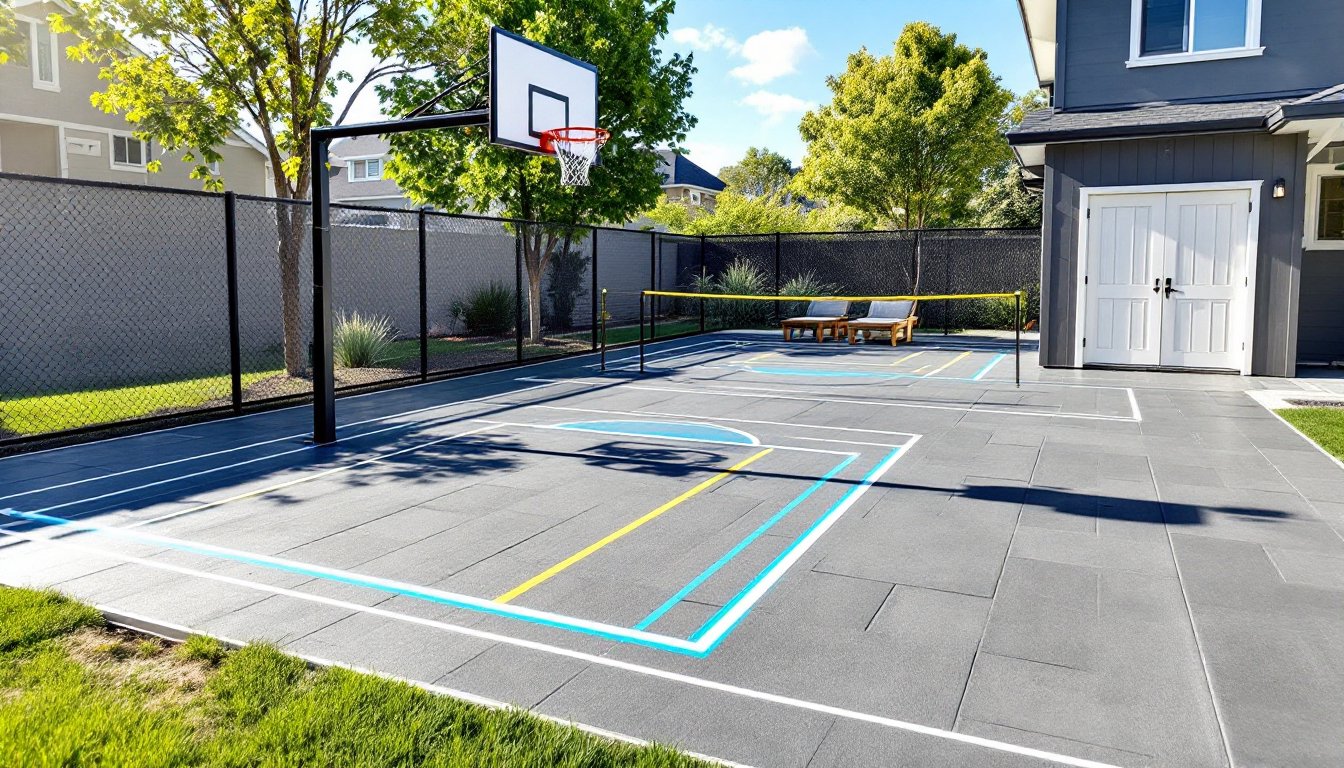
Multi-sport courts maximize versatility in limited space. A standard 30×50-foot court accommodates a half-court basketball setup (roughly 25×25 feet of playing area) plus striping for pickleball, which requires a 20×44-foot court including out-of-bounds zones. Adjustable net systems allow quick switches between sports.
Striping multiple games on one surface sounds cluttered, but color-coded lines prevent confusion. Use white for basketball, yellow for pickleball, and blue for volleyball or badminton. Quality acrylic paint withstands weather and foot traffic for 3-5 years before requiring touch-ups.
Families with younger children often add four-square or hopscotch grids in corner spaces. Roller hockey works on smooth surfaces if homeowners install dasher boards or use portable netting. The key is planning line layouts before surface installation, retrofitting striping costs more and rarely aligns as cleanly.
For those planning broader yard improvements, integrating play structures nearby creates a comprehensive activity zone. Modular tile systems work well for multi-sport courts. Interlocking polypropylene tiles install over compacted gravel bases without adhesives, making them DIY-friendly. Tiles flex slightly underfoot, reducing joint impact during jumping and cutting movements.
Specialty Courts: Tennis, Volleyball, and Badminton
Full-size tennis courts require significant real estate: 60×120 feet including run-back zones per International Tennis Federation standards. Few residential lots accommodate these dimensions, but scaled-down versions work for casual play. A 36×78-foot mini-court fits regulation baseline-to-baseline distance while shrinking doubles alleys.
Tennis court construction demands precise grading and drainage. The playing surface should slope 1% (1 inch per 10 feet) from center to perimeter to prevent puddling. Base layers typically include 6-8 inches of compacted crushed stone topped with 2-3 inches of stone screening before asphalt or concrete.
Post-tensioned concrete costs more upfront but resists cracking better than conventional slabs in climates with freeze-thaw cycles. Acrylic coating systems applied over cured concrete provide the playing surface and traction. Expect to resurface every 4-6 years depending on usage and UV exposure.
Sand volleyball courts offer easier installation. Excavate 12-18 inches, line the pit with landscape fabric to prevent weed growth, then fill with washed masonry sand (not play sand, which compacts poorly). Regulation court size is 30×60 feet, but backyard versions often run 20×40 feet.
Permanent net posts require concrete footings below frost line (check local codes, typically 36-42 inches in northern climates). Portable systems work for casual play but wobble during aggressive net play. Homeowners considering multiple outdoor projects might explore budget-friendly landscaping approaches that complement court installations.
Badminton needs less space, a 20×44-foot court works for doubles. The challenge is wind: even light breezes disrupt shuttlecock flight. Hedges, privacy fencing, or shade structures for outdoor entertaining can provide wind breaks. Grass works adequately for badminton, though low-pile synthetic turf offers better footing without divots.
Choosing the Right Surface Material
Surface selection balances performance, durability, and budget. Each material presents trade-offs in installation complexity, maintenance, and playability.
Asphalt remains the most cost-effective hard surface, running $3-5 per square foot installed over proper base prep. It provides excellent ball bounce and supports all court sports. Downsides include heat absorption (surface temps can hit 140°F in summer sun) and crack susceptibility. Seal coating every 2-3 years extends lifespan. Many outdoor design resources recommend applying acrylic color coatings for reduced heat and improved traction.
Concrete costs more, $6-9 per square foot, but outlasts asphalt by decades. Properly reinforced slabs with control joints handle temperature swings better. Brushed finishes provide slip resistance: smooth troweled concrete is hazardous when wet. Homeowners can DIY small courts (under 500 square feet) if comfortable with screeding and floating, but larger projects justify hiring pros for laser-grading and power finishing.
Modular tile systems range from $4-12 per square foot depending on quality. Premium brands use polypropylene copolymer with UV stabilizers: budget versions crack within two seasons. Tiles drain through perforations, eliminating standing water. Installation is genuinely DIY-friendly, no mixing, curing, or specialized tools. A rubber mallet and chalk line suffice.
Tiles do require a stable base. Excavate 4-6 inches, add #57 crushed stone (3/4-inch aggregate), compact with a plate compactor (rent for $50-75/day), then add 1-2 inches of stone dust or decomposed granite. Screed the top layer flat within 1/8 inch tolerance across the court, tiles telegraph base irregularities.
Synthetic turf suits multi-sport setups where grass sports (soccer, lacrosse) share space with court games. Quality systems cost $8-15 per square foot installed. Look for products with 1.5-inch pile height and silica infill for stability. Cheaper “putting green” turf with rubber infill retains heat and smells terrible by mid-summer. According to experts at regional home design publications, proper drainage underneath synthetic turf prevents the mildew issues common in humid climates.
Crumb rubber infill, while common, raises environmental and health questions. Alternatives include coated sand, coconut fibers, or newer thermoplastic materials. Whatever infill is chosen, budget for top-dressing every 12-18 months, normal play disperses infill to court edges.
Rubberized surfaces (poured-in-place or rubber tiles) excel for impact absorption. They’re standard in playgrounds and work for sport courts where joint stress matters. Cost runs high: $10-20 per square foot. Maintenance is minimal, but UV degradation fades colors and hardens rubber over 8-10 years. For those exploring hardscaping on a budget, rubber surfaces may stretch initial budgets uncomfortably.
Permits typically aren’t required for sport courts as they’re not structures, but check local zoning for setback requirements. Some HOAs restrict court placement or require architectural approval. Lighting triggers different regulations, low-voltage LED systems usually pass without permits, but pole-mounted fixtures over 12 feet may need electrical permits and inspections.
Planning Your Sport Court Layout and Size
Measure twice, excavate once. Start by staking the proposed court area and living with it for a week. Walk around it, visualize play patterns, and check sight lines from the house. Courts located too far from entries don’t get used: equipment stays inside because hauling it out feels like a chore.
Orientation matters. For basketball and tennis, run the long axis north-south so players aren’t staring into sun at critical moments. Morning and late afternoon sun angles cause the most complaints. Homes with expansive outdoor spaces have more flexibility in positioning courts away from sun interference.
Drainage is non-negotiable. Courts must shed water, not collect it. The surface should slope at minimum 1% grade (1/8 inch per foot) toward perimeter drains or daylight. Standing water degrades surfaces and creates safety hazards. In yards with high water tables or clay soil, consider a French drain perimeter, a 12-inch-wide trench filled with gravel and perforated pipe that outlets to a lower area.
Clearance zones prevent injuries and property damage. Add 5-10 feet of buffer around active play areas. Basketball courts need overrun space behind backboards: tennis requires run-back zones behind baselines. Shrubs and flower beds within 8 feet of the court will get trampled, accept this reality during design.
Fencing contains balls and defines boundaries. Chain-link remains the standard: $12-20 per linear foot installed for 10-foot-high residential-grade fencing. Vinyl-coated versions cost slightly more but resist rust in coastal areas. For aesthetics, consider wood privacy fencing on sides visible from living spaces and chain-link on perimeter sections.
Lighting extends playability into evening hours but requires planning. LED fixtures provide the best lumens-per-watt ratio and last 50,000+ hours. Mount lights at least 20 feet high to minimize shadows and glare, pole-mounted floods work better than eave-mounted spots. A 4-pole system with 150-watt LEDs per pole adequately lights a half-court basketball setup.
Run underground conduit during excavation before surfaces go down. Trenching through finished courts is expensive and disruptive. Work within National Electrical Code (NEC) Article 590 requirements for outdoor receptacles and lighting circuits. Pull permits for electrical work: inspectors verify proper GFCI protection and burial depths.
Adjacent seating and storage make courts more functional. A simple equipment shed (8×10 feet) stores balls, nets, and maintenance gear. Benches positioned in shade encourage spectators and provide rest spots during play. Homeowners planning full outdoor entertainment areas often integrate courts with patios, pergolas, and outdoor kitchens.
Budget realistically: A basic 30×50-foot multi-sport court with asphalt surface and simple striping runs $8,000-12,000 including base prep and materials. Premium surfaces, fencing, and lighting can push costs to $25,000-40,000. DIY installation saves 30-40% but requires equipment rental, multiple weekends, and physical labor. Structural work and grading may need professionals even if homeowners tackle finish work.
Phasing projects helps manage cash flow. Install the base and surface first year, add fencing the next season, and upgrade lighting later. Courts remain functional during phased builds. Just ensure the base meets final specifications, retrofitting drainage or leveling after surface installation multiplies costs.
For yards in regions with specific climate challenges, like the heat of Texas outdoor spaces, factor in shade structures or lighter-colored surfaces that reflect rather than absorb heat. Desert and southern climates benefit from strategic tree planting or shade sails to make summer play tolerable.
Conclusion
A backyard sport court transforms how families use outdoor space, converting passive lawn into active recreation zones. Success depends on realistic planning, matching court type and surface to available space, budget, and intended use. Proper base preparation and drainage prevent the failures that plague budget installations, while strategic material choices balance performance with long-term maintenance. With careful design and honest assessment of DIY capabilities versus professional help, homeowners can build courts that deliver decades of play.